
Crude Realities
How Oil Continues to Fuel Power, Politics, and Conflict

By Matthew Heibel
Petroleum, perhaps you’ve heard of it. It was only arguably the most important substance of the 20th century – powering two world wars while its products replaced many traditional (and colonial) resources. Oil lifted previously peripheral states to international prominence. Countries used supply control as a weapon or lever in the contact sport that is international relations. And, despite the rise of renewable energy, it continues to be a necessity in the modern world.
This newsletter, the second in our Resources series, will focus solely on petroleum, which includes not only crude oil that is drilled out of the ground but also all its refined products (we will use oil interchangeably as a shorthand for ease of reference). It will not cover natural gas, which deserves its own future newsletter.
Oil versus natural gas:
While both oil and natural gas are fossil fuels with a number of key similarities, and both are hugely important as energy sources today, there are several key differences:
Oil is generally in a liquid state, whereas natural gas is, naturally, a gas;
Oil is a more energy-dense material, meaning it generally produces more energy per volume than natural gas;
Oil is a complex mixture of hydrocarbons, whereas natural gas is mostly Methane (CH4);
Natural gas burns much cleaner (producing fewer emissions) than oil;
Refining oil into usable products is a much more complex process, whereas natural gas refinement is a simpler process – mostly ridding the substance of impurities;
Natural gas is generally cheaper than oil;
Natural gas is mostly used for commercial and residential heating as well as electricity generation.
To be clear, we are also not touching on coal—the other prominent fossil fuel—in this article. Coal produces more carbon dioxide emissions than either oil or natural gas and is the worst of the three in terms of air pollution.
Uses of petroleum - Not just petrol
Somewhat surprisingly, a 42-gallon (159-litre) barrel of crude oil actually produces 45 gallons (170 litres) of usable petroleum products during the refinement process, much the way popped popcorn is a higher volume than the initial popcorn kernels.
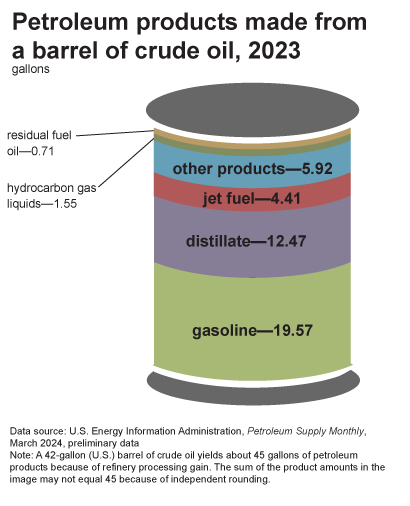
Breakdown of a barrel of crude oil from EIA
Petrol, or gasoline, is the most common and most well-known oil product, but the full list of petroleum products and the industries it spans is staggering. In transportation, it produces jet fuel (for commercial and military aircraft) and rocket fuel (for NASA and billionaires’ fantasies). For a while yet, you can’t make it to the moon, let alone Chicago, if you want to fly electric. In health, it is used in everything from antiseptics and aspirin to deodorants and hearing aids. In leisure, you can find petroleum in backpacks, tents, tennis rackets, beach umbrellas, balloons, and surfboards. In industry, you can find it in asphalt, adhesives, caulking, tubing, vinyl flooring, and antifreeze. The next time you put on a piece of clothing that has spandex, polyester, or nylon, you can thank petroleum for its products that are water-resistant, elastic, and wrinkle-free. The list below is even more expansive.
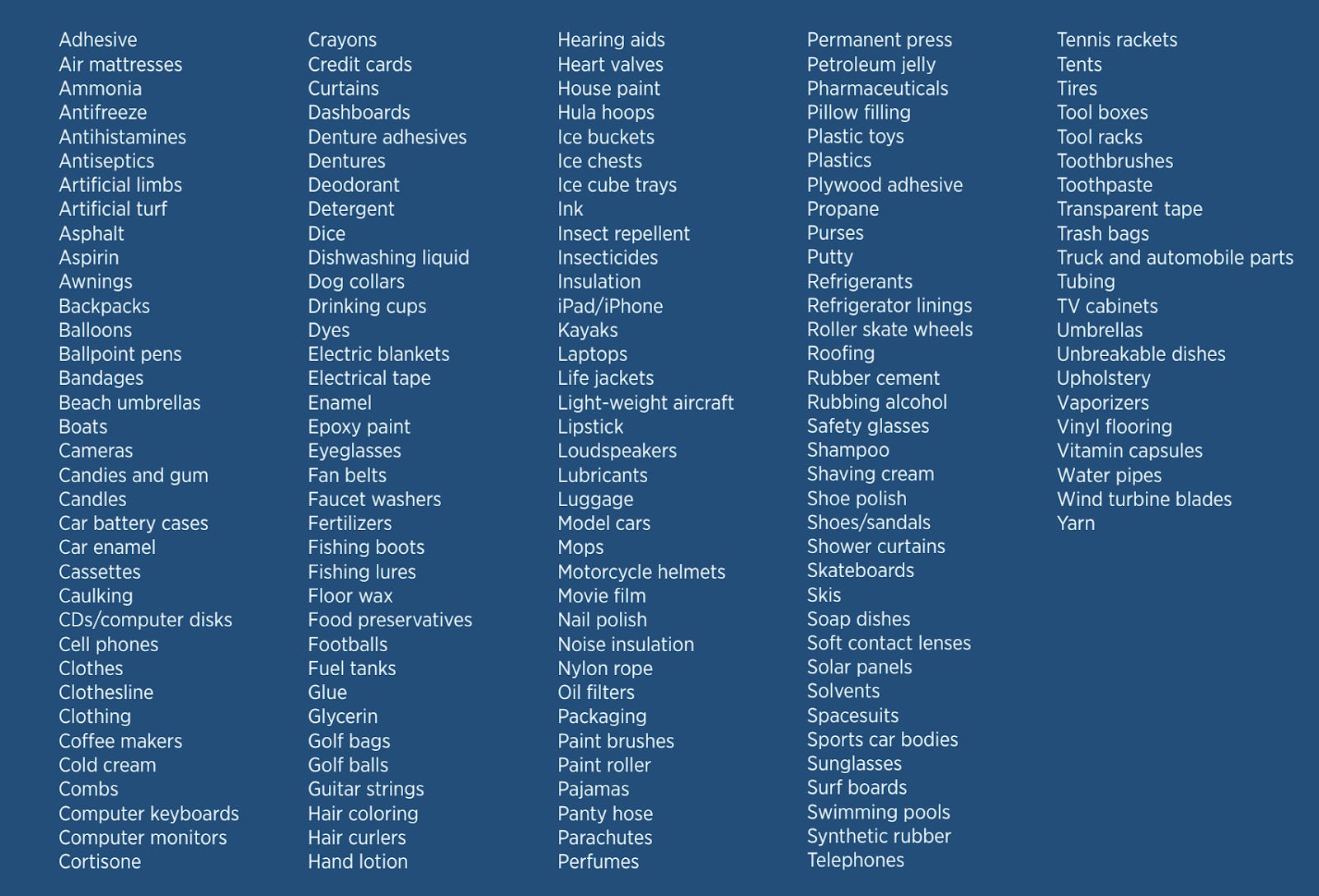
Products Made from Oil and Natural Gas from The US Department of Energy
There is a good argument that innovations in petroleum products as substitutes for natural resources helped the U.S. win World War II. For example, once Japan occupied Indonesia, then called the Dutch East Indies, they cut off the U.S. from 92% percent of its rubber – rubber being a key material in parts of tanks and airplanes. U.S. scientists, using petroleum, managed to produce synthetic rubber within months, allowing the U.S. war machine to continue uninterrupted. In clothing, polyester helped alleviate the need for cotton and wool. In short, petroleum was nothing less than the miracle material of the 20th century, powering transportation from cars to rockets and lessening dependence on natural resources available only in far-off places.
Renewable sources of energy, all of which produce electricity, may have lessened petroleum’s grip on certain industries like the automotive one, but so far, no one has found a suitable substitute for petroleum in war machines like tanks, let alone commercial aircraft, or the dozens of everyday materials listed above. Like it or not, petroleum will continue to be an incredibly important substance for the foreseeable future.
The rise of the petrostate
In the early 1900s, the United States was the unquestioned leader in oil production, with fields from Texas to Pennsylvania flowing with black gold. After World War II, the world entered an era of decolonization, with the number of nations skyrocketing. It coincided with a shift from coal to oil, and the rise of states that happened to sit on vast oil reserves. This history has many dark moments. The U.S., via the newly formed Central Intelligence Agency (CIA), orchestrated a coup against Mohamed Mosaddegh, Iran’s democratically elected leader, in 1953. This coup happened in part due to Great Britain, the U.S.’s staunchest ally, being upset that Mosaddegh nationalized the Anglo-Iranian Oil Company – now known as British Petroleum (BP). It left the people of Iran in the hands of the U.S./British-approved Shah and his brutal tactics.
Oil also put several states on the map. Norway, for example, has benefited massively from oil since the first large oil reserve was discovered in the 1960s. Through wise investment and wealth management, it has become one of the richest nations per capita in Europe. On the other side of the Atlantic, Venezuela in the 1920s was one of the first nations after the U.S. to experience an oil boom. It was a founding member of the Organization of the Petroleum Exporting Countries (OPEC), and even though it has fallen on extremely hard times, it still possesses the largest known reserve of crude oil, meaning it has a viable path back to solvency if it can fix its government.
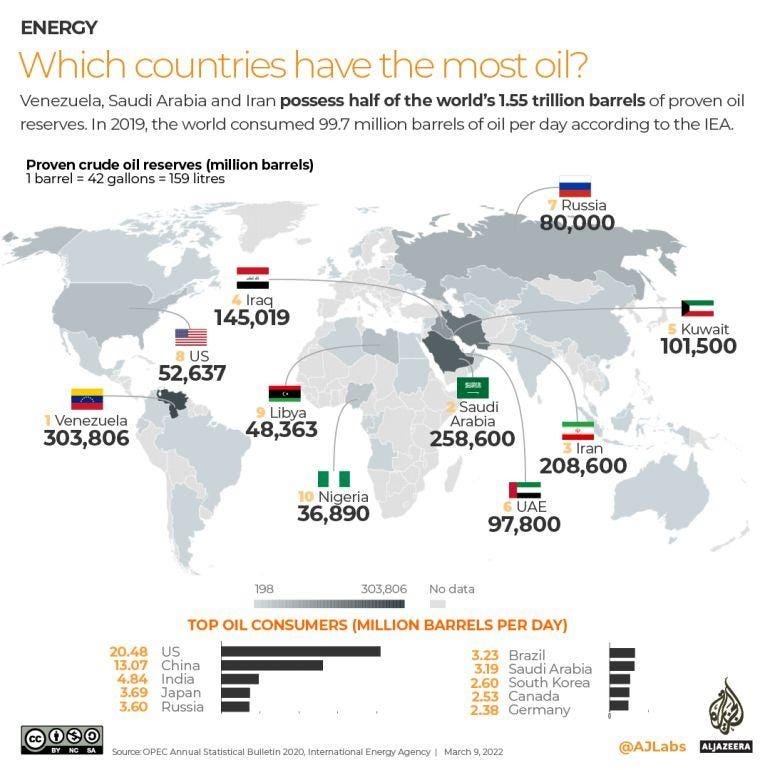
Oil reserves by country from Al Jazeera
The country that likely comes to mind when thinking about oil, and the largest producer in OPEC, is Saudi Arabia. A country previously well-known for hosting Islam’s most important holy sites in Mecca, Saudi Arabia, vis-à-vis its oil production, has given itself a seat at the table in regional, if not global affairs. OPEC, founded by Iraq, Iran, Kuwait, Venezuela, and the Saudis in 1960 to counter the “seven sisters” of major British and American companies, has long sought to leverage its collective oil production for its own interests. In 1973, due to the Arab-Israeli War, OPEC declared an oil embargo against the United States. While the U.S. was not without reserves to give itself a short-term reprieve, the embargo nevertheless sent shockwaves through the U.S. economy and forced the U.S. to negotiate an end to the embargo that included securing peace in the Arab-Israeli War. It left the U.S. shell-shocked and with diminished clout on the world stage while showing what a few small countries blessed with oil could do to a superpower. You’d be hard-pressed to find a better example of control of a commodity as leverage.
Fracking: The shale revolution
Ever since the OPEC oil embargo, Western nations and the U.S. in particular have realised the importance of energy independence. Having to constantly prostrate to Middle Eastern autocrats was both a national security issue and embarrassing to nations that saw themselves as liberal democracy’s standard bearer. Enter hydraulic fracturing, commonly known as fracking, which is the process of pumping in water, sand, or other chemicals into rock or shale to help release oil or gas reserves (which is why it is often called the Shale Revolution). Fracking has completely changed the game for the U.S. It has technological roots in the 1970s, but it really came into form in the 2000s after the Iraq War and coup in Venezuela, and has hugely benefited the U.S. and Canada. Due to fracking, in 2004, Canada became the U.S.’s largest supplier of foreign oil, surpassing Saudi Arabia, and in 2011, for the first time the U.S. became a net exporter of petroleum products.
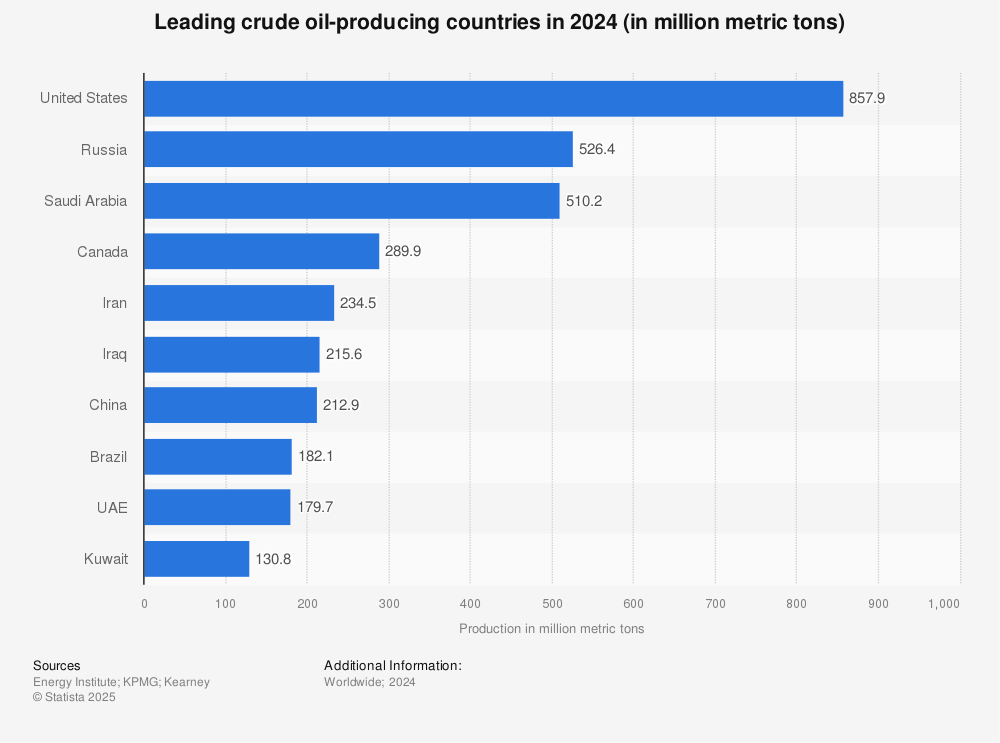
2024 worldwide oil production from Statista
Geography, including what resources you have under your ground, is often considered static, but sometimes technology can bring about a huge change in geography. With fracking, all of a sudden, solely via the invention of a new technology, the U.S. now had access to millions of barrels of oil that were always there but not extractable. Environmental groups will say that the process is not all it’s fracked up to be, with it being linked to contaminating drinking water, but considering it has freed the U.S. from dependence on foreign oil, it is almost certainly not going to be abandoned.
Oil at the center of the Russian invasion of Ukraine
One area of the world not fortunate enough to benefit from the shale revolution is Europe. Outside of Norway, and to a lesser extent the U.K., Europe is not blessed with an abundance of oil, hidden in shale or otherwise. Prior to Russia’s invasion of Ukraine in February 2022, Russia was Europe’s largest supplier of oil by a significant margin.
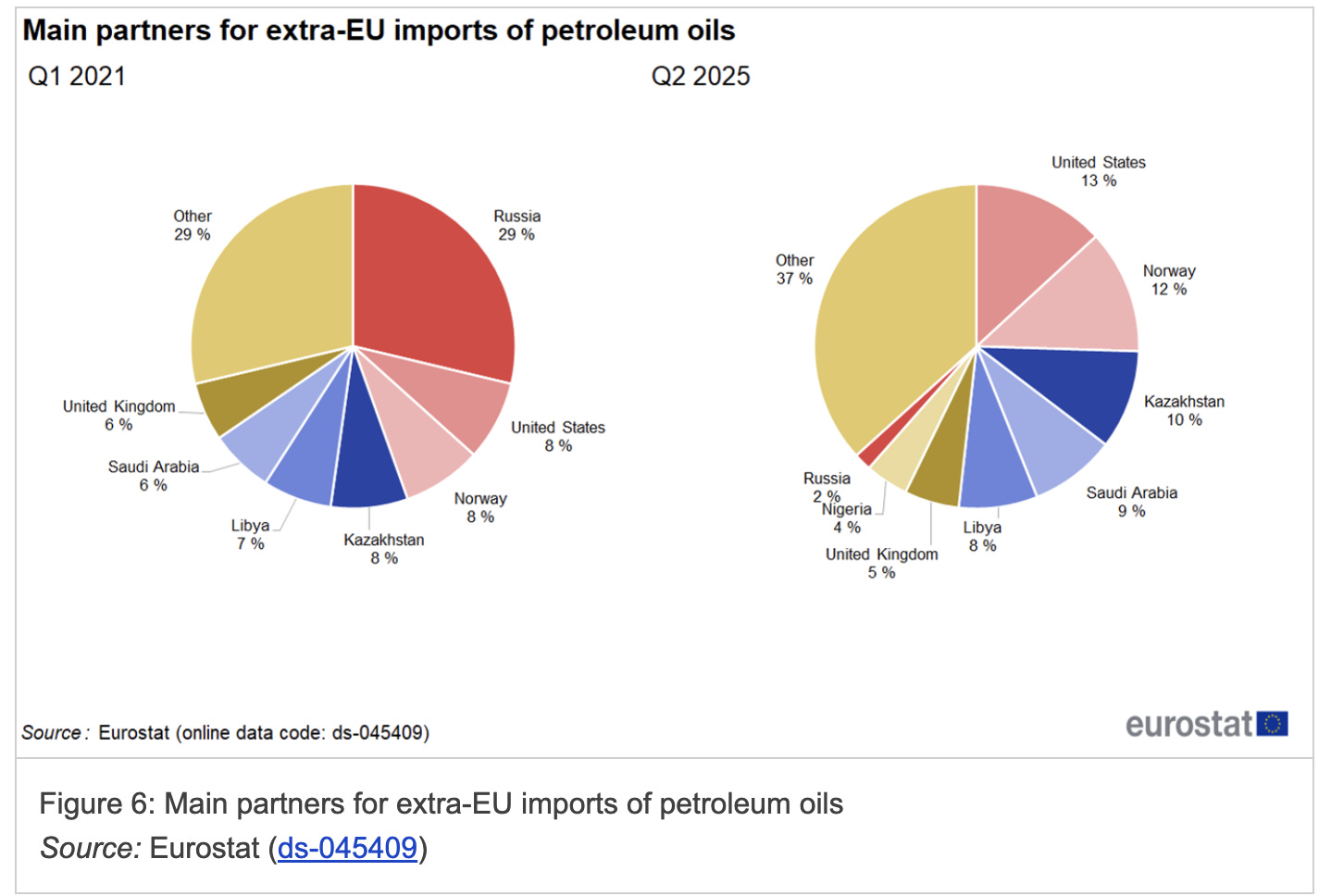
Change in European oil supply between 2021 and 2025 from Eurostat
In the 2010s, it was a commonly held view that Russia could sideline the Europeans in any potential conflict simply by threatening to turn off the gas. Russia’s invasion of Ukraine put this theory to the test. So far, instead, Europe has galvanised their plans for diversification - one of the key pillars underlying their RePowerEU strategy implemented following the invasion in 2022. The U.S.’s oil exports have helped, as have imports of liquified natural gas (LNG) for heating and renewables filling some of the void. It may even be the case that Russia, having played this card, has forced Europe to finally break its addiction to Russian oil. Increased supplies from North Africa, the Turkish route, and from Kazakhstan have all looked to replace the Russian supply from a variety of sources (so as to not trade one dependency for another).
On the flip side, heavy sanctions by the U.S. and its allies on Russian oil have jeopardized Russia’s ability to wage war. With 30-50% of the total Russian budget coming from oil and gas, the West is trying to squeeze Russia’s most vulnerable pressure point, while Russia knows it cannot afford to lose any more customers. Sanctioning Russian oil does not mean an embargo. Instead, what Western allies did was put a price cap on Russia’s oil. This meant that Russia was allowed to sell its oil only at a certain price, which is lower than the global price. This limits the revenue Russia receives from oil while keeping the global price of oil otherwise stable.
Russia has tried many different strategies to circumvent these sanctions, including using a shadow fleet of oil tankers – older ships from third-party nations that cannot be easily traced back to Russian ownership, so that oil on board can be sold at the global price. It is also selling its oil at market price to other petrol-hungry nations that aren’t allies of Ukraine, including China, India, and Turkey, despite U.S. pressure on these nations not to buy from Russia.
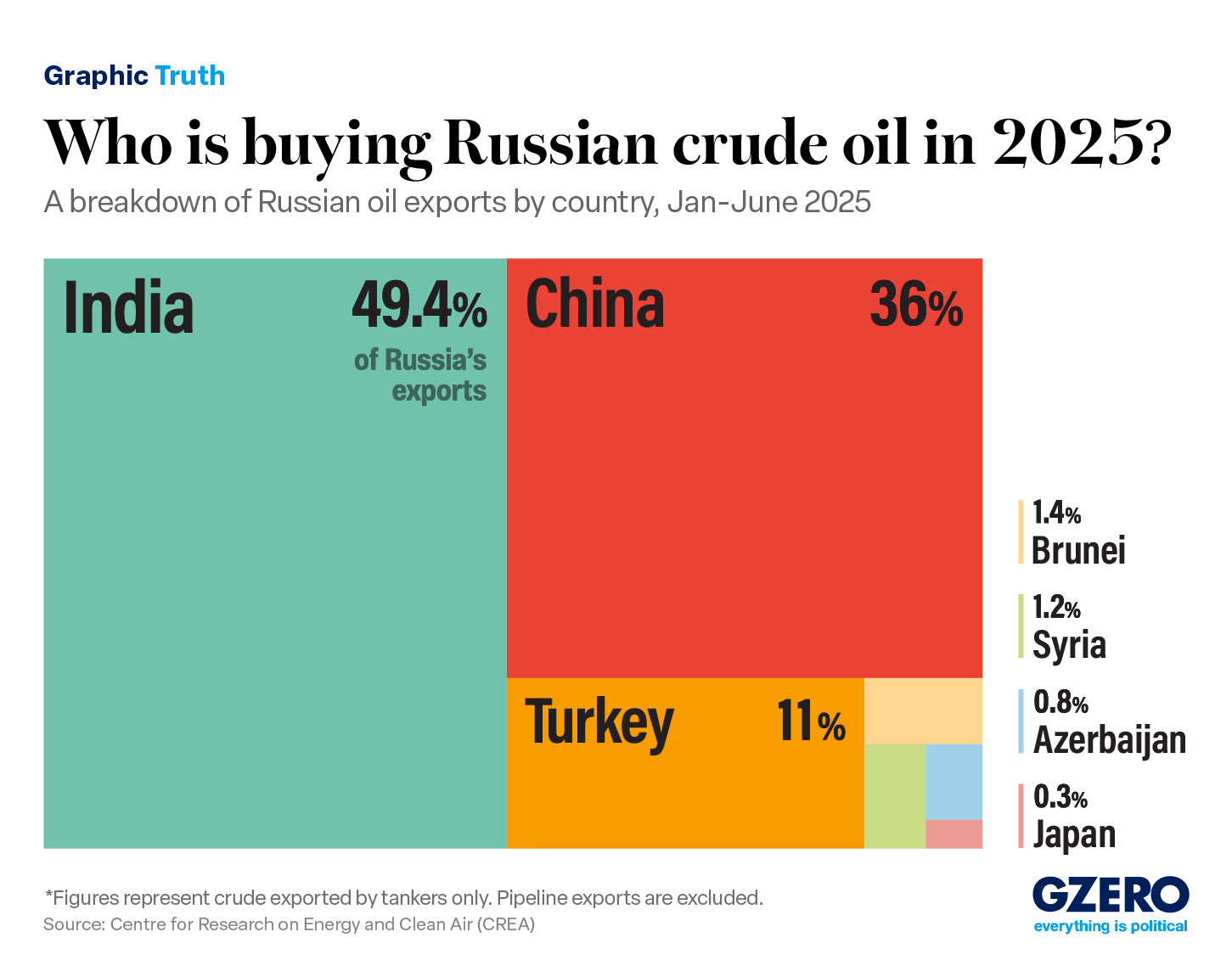
Russian oil purchases in the first half of 2025 from GZero
Who wins the war over oil will likely be the winner of the conflict. Will Europe still be able to survive without significant Russian oil imports? Can the West effectively kneecap Russia’s primary industry such that it brings Russia’s economy to the point of collapse and forces Russia to stop the invasion? Or will Russia find a way past Western sanctions by hook or by crook to keep the revenue and its war machine flowing? While the answer is unknown, what is certain is that oil, even in the 21st century, retains its position as one of the key substances in geopolitics.
Matthew Heibel is a licensed U.S. lawyer with over 15 years experience as a criminal prosecutor, focusing on bringing rapists and child molesters to justice. He served in the US Air Force as a JAG (military lawyer), and was stationed in Japan, Kuwait, and the U.S. Currently he is pursuing a Masters in Geopolitical Studies at Charles University in Prague while also serving as a geopolitical consultant for Aspen Institute Central Europe.
Ronan’s Pickle Jar
While most of the world largely and justifiably is looking to diversify away from oil and other fossil fuels, a new arena for competition is emerging between the U.S. and China. While Beijing has long struggled with being very energy poor resulting in large dependencies, they have looked to rapidly expand renewable electrification (while still opening coal power plants), to reduce external dependencies. Their manufacturing support has been so successful that it is now cheaper to produce energy from new solar panels than any other source.
At the same time as Beijing goes all in on renewables, the U.S. has doubled down on oil with Trump often heard repeating “drill baby, drill” in reference to opening up new oil fracking and exploitation opportunities while reducing red tape and regulation. The administration has made this a high priority and meant that the already expanding oil exploration and tapping operations under Biden have only accelerated.
The result is a rapid transition on the global stage as leaders in renewable energy as could be seen by the recent COP30 where the U.S. refused to even attend. While Washington — previously seen as a global leader, has chosen to abdicate it’s position — Beijing has been happy to step into the position and reap the soft power benefits in much of the developing world. The tangible outcomes of this strategic decision are not likely to be seen until a decade or two down the line where decisions now will have serious consequences. China having secured such a dominant market position, the economies of scale will only further price out potential competitors.
While oil is likely to be an essential commodity in manufacturing for the foreseeable future, it is in transportation that the shifts will be felt largest. Currently road freight is about one-fifth of global oil demand and roughly half of all diesel use. Since trucks dominate diesel, electrifying freight directly bites into one of oil’s biggest end-uses and reduces the scalability as more trucks turn towards electric. Likewise, light vehicles (cars/SUVs) make up between 25–30% of global oil usage, and again Beijing dominates manufacturing, innovation, supply chains, and uptake.
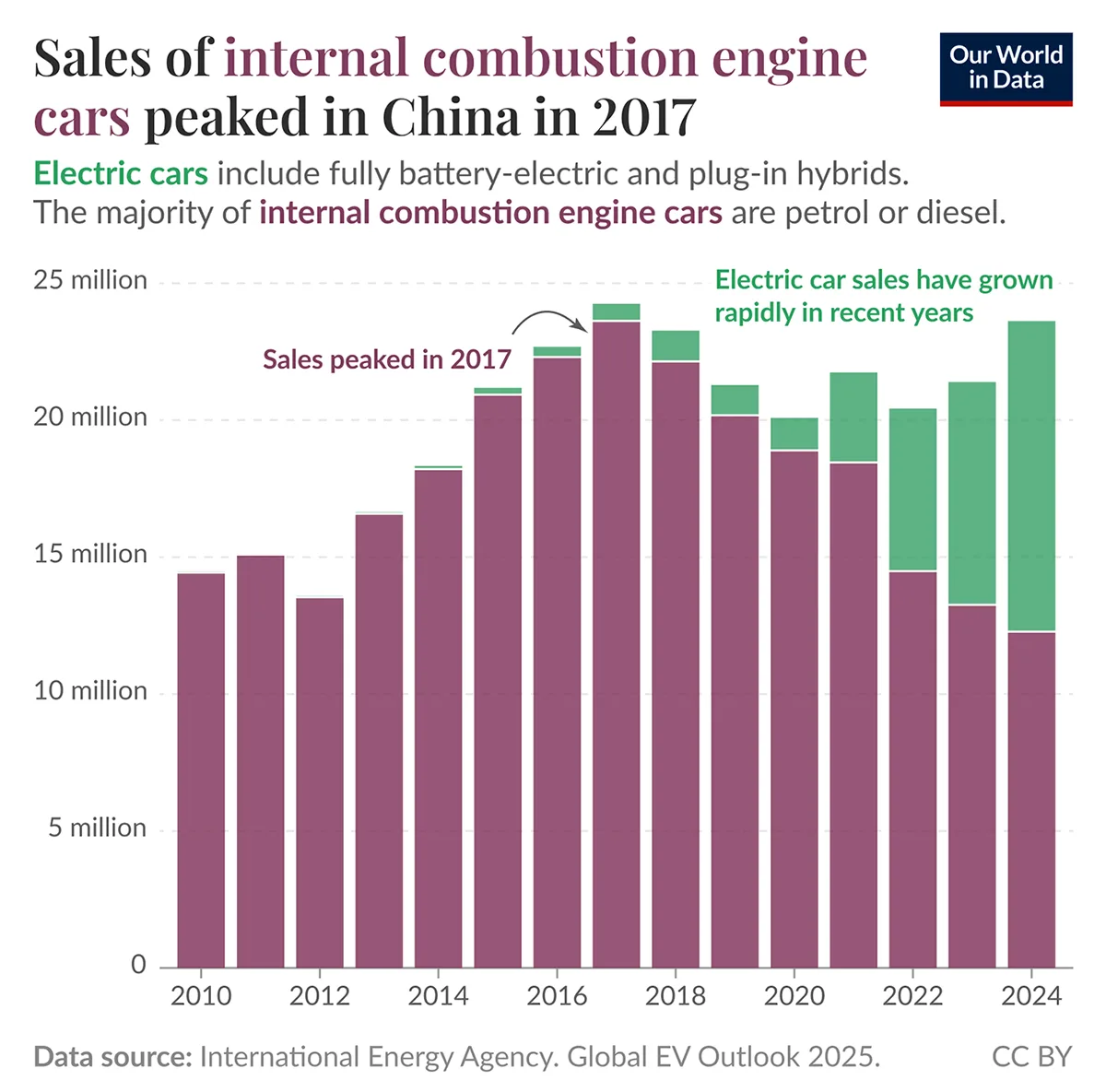
Chinese new vehicle sales 2010-2024 from Our World in Data
The trend towards electrification is irreversible, whether Washington wants to drill more oil or not. Beijing has ensured that the writing is on the wall for the petro-state and is attempting to guarantee that the 21st century will be dominated by the electro-state – a mantle they are eager to hold.
If you like what we do here at The Pickle Gazette, please share and subscribe so that you get every new issue delivered straight to your inbox.